BLOG

Honoring Dr. King Beyond ‘I Have a Dream’

I’m not a teacher. I work with students at one of the best charter schools in the city. My technical title versus what I actually do is complex, hence the “I work with students.” Like most New Yorkers I have a day job and a few side hustles. The day job serves as a consistent pay check, but is not necessarily connected to the “dream” that I moved to the city to pursue. On the side I pursue my passion by writing for every publication that will pay me to opine or report. In addition, I work independently with clients who hire me to edit their work or assist with their independent projects.  But back to my day job.

About a week ago all of the classrooms in the building started working on their special projects to honor Dr. Martin Luther King Jr. for MLK day, which this year falls on today although his actual birthday is January 15. I scoured over the pictures of MLK that my first graders had colored. I carefully read their two sentence interpretations of his famous “I Have a Dream” speech. And I even read one of the elementary school reading level book Happy Birthday, Martin Luther King. The book, similar to the projects teachers had created for their students, similar to revisionist history, all completely watered down the legacy of Dr. King. Every thing taught to the students was only a short excerpt from his “I Have a Dream” speech. No wonder so many Americans have this fairytale, romanticized ideal of who Dr. King was. The sad thing is all they have to do is read what he actually said to realize he was not this singular passive man who just wanted to sing kumbayah and hold hands. He was angry about the conditions Blacks faced in America. And he called people out.

In college I was one of the righteous ones who thought King wasn’t militant enough. I was a Malcolm X girl all day. I rarely wanted to hear much about the contributions of Dr. King because it was my belief that he kow-towed to white people and their power structure. I was uninformed and wrong. Thankfully I had the honor of taking a class with Dr. Amiri Al-Hadid who co-authored Between Cross and Crescent: Christian and Muslim Perspectives on Malcolm and Martin. He was also the head of the Great Debate team, which I was a member of on the El Hajj Malik El Shabazz (Malcolm X) team. Dr. Al-Hadid encouraged us to expand our simplistic beliefs of who both of these men were, which required a lot of time and study.

In honor of Dr. King I reread his “Letter from a Birmingham Jail” and “The Other America.”  I ask myself: how can educators or parents teach children about Dr. King beyond the surface of what they’re learning in their dumbed down textbooks? It may seem like a simple answer, but I can assure you many of the parents of my students don’t know Dr. King’s legacy themselves, let alone understand what the school is teaching is watered down. Perhaps if we start with the babies we will eventually have less Americans who love Dr. King’s hope of people being judged by the content of their character and not by the color of their skin, but couldn’t tell you the first about his stance on poverty, the war, pulling oneself up by the bootstrap and being disappointed by white pastors who refused to align themselves with justice. I don’t have all the answers. But I recognize the disservice being done to our youth and Dr. King when we refuse to learn (and teach) the complexity of him as a man, a father, son, a husband, a Pastor, a leader, a speaker and an activist.

Happy Birthday, Dr. King. May we never stop learning.

From Dr. King’s speech: “The Other America” March 14, 1968

I want to discuss the race problem tonight and I want to discuss it very honestly. I still believe that freedom is the bonus you receive for telling the truth. Ye shall know the truth and the truth shall set you free. And I do not see how we will ever solve the turbulent problem of race confronting our nation until there is an honest confrontation with it and a willing search for the truth and a willingness to admit the truth when we discover it. And so I want to use as a title for my lecture tonight, “The Other America.” And I use this title because there are literally two Americas. Every city in our country has this kind of dualism, this schizophrenia, split at so many parts, and so every city ends up being two cities rather than one. There are two Americas. One America is beautiful for situation. In this America, millions of people have the milk of prosperity and the honey of equality flowing before them. This America is the habitat of millions of people who have food and material necessities for their bodies, culture and education for their minds, freedom and human dignity for their spirits. In this America children grow up in the sunlight of opportunity. But there is another America. This other America has a daily ugliness about it that transforms the buoyancy of hope into the fatigue of despair. In this other America, thousands and thousands of people, men in particular walk the streets in search for jobs that do not exist. In this other America, millions of people are forced to live in vermin-filled, distressing housing conditions where they do not have the privilege of having wall-to-wall carpeting, but all too often, they end up with wall-to-wall rats and roaches. Almost forty percent of the Negro families of America live in sub-standard housing conditions. In this other America, thousands of young people are deprived of an opportunity to get an adequate education. Every year thousands finish high school reading at a seventh, eighth and sometimes ninth grade level. Not because they’re dumb, not because they don’t have the native intelligence, but because the schools are so inadequate, so over-crowded, so devoid of quality, so segregated if you will, that the best in these minds can never come out. Probably the most critical problem in the other America is the economic problem. There are so many other people in the other America who can never make ends meet because their incomes are far too low if they have incomes, and their jobs are so devoid of quality. And so in this other America, unemployment is a reality and under-employment is a reality…

…The first thing I would like to mention is that there must be a recognition on the part of everybody in this nation that America is still a racist country. Now however unpleasant that sounds, it is the truth. And we will never solve the problem of racism until there is a recognition of the fact that racism still stands at the center of so much of our nation and we must see racism for what it is.


Dope Writers

I’m fighting sleep on the LIRR as I type this on my Blackberry. Today I logged on to Twitter (I know I said I was taking a hiatus, but focus mayne) to see two veteran writers had tweeted one of my recent posts. Meant very little to them to tweet it and mention admiration me for writing it, but it meant the world to me.

In November 2009 I started blogging without really knowing where the blog would take me. But I knew as a new unknown writer/journalist I had to have one. Its been two years of ups and downs. But in 2009 I would have never imagined that I would receive a number of emails per day from readers and aspiring writers saying I’ve inspired them, or asking me for advice on how to break into this industry. Trust, I’m still trying to figure out the answers myself. Today I realized I’ve never shared some of my favorite writers who have influenced me along the way. Admittedly, I’m apprehensive as hell to write this list out of fear that I may leave off a writer whose work I adore. But off the top, before I ever had a blog or a published article, here are the writers that make me want to throw away my pen and burn everything I’ve ever written.

Gloria Naylor

I fell in love with Ms. Naylor as an English literature major when I was 17. Dr. Rebecca Dixon, one of the smartest women I know, listed Naylor’s Linden Hills and Bailey’s Cafe on our syllabus as required reading for the semester. Linden Hills had me hooked from page one. Creating circles of hell similar to Dante’s Inferno with black elite characters dealing with a host of family issues was genius to me at 17-years-old. Her most notable work, Women of Brewster’s Place, was made into a movie featuring some of Hollywood’s budding black actors and actresses, including Oprah. Naylor’s storytelling capabilities are worth more praise than she gets.

 Flora Nwapa

Efuru is one of my favorite books, and one of the best I’ve ever read. You become Efuru as you read. I don’t know if Nwapa purposely wrote with a feminist perspective in mind when she wrote the book in 1970, but one cannot help but applaud the independent women in her novel. Nwapa must certainly be on the top of any African literature list. I love her for this one book alone.

Jill Nelson

She is the reason I went to grad school for journalism. If I had to recommend any book to young writers it would be Volunteer Slavery: My Authentic Negro Experience. What she endured working for the Washington Post as a black woman will both move and anger you. Her story is compelling and witty. It’s a page turner worth every word on all 256 pages. I’m not kidding when I say I read her book and started researching grad schools for journalism. After reading her story I thought I could be the change I want to see in media.

Joan Morgan

This should be obvious on so many levels. She’s in my freakin’ bio. Morgan’s When Chickenheads Come Home to Roost is also another reason I went to grad school to study journalism. I saw major similarities between Morgan (based on her book) and my twentysomething self. The love for hip-hop, loathe of sexism, embracing feminism, being a writer– the influence was instant. Chickenheads is a must read. And the fact that I can read it repeatedly is a testament to her writing and the necessity of this book.

dream hampton

Can I be honest with y’all for a minute? I wasn’t up on dream until mad late. My first time hearing of her was in ’09/’10. I know, I know. As a journalist who wants to cover music this is like blasphemy. When I finally learned who she was I spent hours reading her work. In addition to her mastery of the craft, dream is brilliant. She knows so much about damn near everything. Nerds rock. If I’m off Twitter her timeline is the one I will check. Her writing is poetically beautiful. She makes words sing. dream is hands down one of the best writers of her generation. Free the Girls says it all. I’ve tried to imitate her. I can’t. Never would be able to. No one can. She’s that fucking good.

Danyel Smith

Journalist. Author. Former Editor-in-Chief. Current EIC. Commentator. I can go on and on about her accomplishments. I love me some DSW. Shoutout to VIBE for archiving those 90s issues on Google books. I hit up Google books for hours and read her old articles. If there was anyone’s career I’d like to mirror my own after it would be this woman. Who do you know that can leave the game, go get an M.F.A. in Creative Writing, write two books and come back as the EIC of a legendary magazine? Exactly.

Denene Millner

If you don’t know you better ask somebody. Way before relationship gurus hit the scene there was What Brothers Think, What Sistahs Know by Denene and her hubby Nick Chiles published in 1999. My mom still has that purple book in her personal library. She is a NYT Bestselling author who has penned over 19 books. Yes, 19. Damn I’m slacking. Denene is an amazing writer and journalist. Her piece “The Attack Against Black Girl Beauty” gave me chills. Actually, I think I shed a tear. A true testament to her skills.

Percival Everett

Read Erasure. #enuffsaid

Alice Walker

The Third Life of Grange Copeland was the book that made me a believer that Walker was not all hype.

Ta-Nehisi Coates

I subscribe to The Atlantic because of this dude. Well, The Atlantic is one of my favorite magazine so that’s not completely true, but hey, it sounded good. Seriously, few people slay the way he does. His intellect is razor sharp. And not intellectual in the way that makes his work boring and difficult to understand. Reading Coates makes you go look some shit up if you’re uninformed. Every time I read him I pray that my writing can only be 1/4 as smart as his. Jesus Buddha Joseph Mary, about that unanswered prayer…

Shakespeare

Don’t know nothing about the allegations that Shakespeare didn’t write any of his works. What I do know is that I’ve read majority of Shakespeare’s comedies. Merchant of Venice and As You Like It are at the top of my list. Here’s why I personally like Shakespeare: not only was the writing Shakespearean, he wrote storylines that were straight up some everyday life drama. No, seriously. If you could get past the language it was mostly tales of infidelity, sex, betrayal, jealousy, greed, judgmental folks, family quarrels and more. Gangsta.

Virginia Woolf

Lover’s of literature praise Woolf for A Room of One’s Own. I, however, personally dig Mrs. Dalloway, which is said to be in the top 100 best books of literature of all time. I wouldn’t say her writing inspired me per se. She’s a notable writer nonetheless. Plus, I can’t have y’all thinking my library isn’t diverse. I got some Wally Lamb, Salman Rushdie, Anita Diamant, Edith Wharton, Graham Greene and Steven Pressfield in my collection.

Linda Hobbs

Linda is so lowkey she will probably tell me to remove her name from this list. But I won’t. She’s one hell of an investigative reporter. She broke the story of the Chris Stokes molestation allegations in VIBE. I don’t care if Linda rewrote the phone book, I’d read it.

Demetria Lucas

This chick right here? I discovered her blog a couple years ago. Here was this woman living out this dream life in NYC as a writer. To top it off the transparency in her writing was totally relatable. She quickly became one of the writer’s whose blogs I checked daily. I’ve even read some of her blog posts three times. A Belle in Brooklyn didn’t disappoint. When young writers hit me up I tell them to go read Lucas’ and Aliya S. King’s blog so they understand, this writer’s life ain’t easy. But it’s well worth it.

Aliya S. King

Speaking of Aliya S. King, Aliya is just awesome all the way around. I read Platinum in one sitting. Before that I would devour her blog dedicated to helping new writers. I have read every single post on this woman’s blog. Does this sound creepy? No? Ok, good. I say it all the time, I don’t stan for celebs. I stan for great writers. What I like about Aliya is she is still very much that down to earth chick from Jersey. I emailed her as a semi-unknown writer in ’10. It took her months, but she got back to me answering my questions. When I met her in person she had that  same warm and inviting spirit. Her dedication to helping young writers is admirable. I hope to give back in the way she has.

Greg Tate

Greg breaks it down so it can forever be broken. If there’s one person who I think was born to write, it’s Greg. He has an undeniable natural gift. And this man truly makes me want to quit writing forever.

Others notable mentions: Octavia Butler, Toni Morrison, Jean Rhys, Edwidge Danticat, Chinua Achibe, Edith Wharton, Terry McMillan, Zora Neale Hurston, Nella Larsen, Walter Mosley, James Baldwin, Karen Marable Good, Akiba Solomon, Vanessa Grigoriadis, Shanel Odum, Elizabeth Mendez Berry, George Nelson, Lola Ogunnaike, Dan Charnas and kris ex.

Who are some of your favorite writers? And what books are a must read?

Haters

“If I don’t like it, I don’t like it, that don’t mean that I’m hating.” – Common

I don’t even like the word. I also don’t use it in every day conversation.

My recent post, “An Open Letter to Tyler Perry,” has been quite the buzz for the past week. It has been reposted on various online publications and discussed on local radio stations (shoutout to 97.1 in Greensboro, NC for reading an excerpt on their program Sunday). Readers set the comments on fire with their agreements and disagreements with my position. Total strangers on Twitter and Facebook have hit me up with their thoughts, and my email hasn’t stopped buzzing since the day I posted the blog. In the majority of those emails both women and men have thanked me for writing the “truth” about TP’s depiction of black women. What I found interesting was the number of people who expressed that in their attempts to have this same discussion in the past, they were immediately called “haters.” People accused them, just like some commenters accused me, of hating on Tyler Perry because we disapproved of the tropes he uses in his works.

Black people, this has to stop.

It has been nearly a decade since the term hater has been frequently used by the masses. Loosely translated, we consider someone a hater if they hate seeing someone do well or doing better than them. When hater became the latest pop culture catch phrase, rappers went in the studio to lay tracks about their haters. Pastors preached from the pulpit on Sunday morning about letting God take care of your haters. And folks couldn’t wait to tell you how many haters they had. “She’s just hatin’,” your bestie would say. Then they’d rattle off a laundry list of everything people were allegedly hating on: “She’s hating because her man wants me.” “He’s hating on me because he’s broke.” According to some, everyone was a hater. And everyone had haters.

Due to our history in this country black people have had an unspoken rule that we don’t air out our dirty laundry for white folks to see or hear. Any internal issues within the black community we must air them out behind closed doors so the white folks can’t look on and pass judgment. Doing otherwise would result in major backlash and could get you accused of being a traitor to the race. But the truth is that within the black community we’ve always had public disagreements. We’re not monolithic so everyone isn’t going to be on one accord.

Booker T. Washington and W.E.B. DuBois publicly disagreed. DuBois and Marcus Garvey had a major public beef. Malcolm X and Martin Luther King were heavily critical of one another’s ideologies. Despite what Alex Haley wrote in Malcolm X we learn in Dr. Manning Marable’s book that in actuality Malcolm X was never moving toward aligning his ideas with integration as inaccurate history will suggest. Langston Hughes was an extremely vocal critic of Zora Neale Hurston. Only during those times the Internet didn’t exist so one’s critique of another artist did not spread all over the world wide web. But the critiques still existed.

Clearly I don’t subscribe to the notion that blacks should not critique one another in the public sphere. Nor am I of the belief that because something is black it should automatically be supported (even though I try my hardest to support things that are black owned, black written, black produced, black art, etc., but if I don’t like it I don’t like it). We have to think beyond this philosophy that someone not being a fan of someone’s artistry means they’re hating. It’s illogical and an anti-intellectual lazy argument.

Critique and dislike of something does not equal “hating.” It really does us a disservice to continue thinking along these lines.

The other day I wrote about finishing Assata’s autobiography in two days. One of the passages that stuck with me was toward the end when she was describing joining the Black Panther Party. She went on to explain the party she fell in love with was no longer what she’d envisioned, which eventually led to her leaving the BPP. What struck me was her personal opinion of one of the major reasons she believes the BPP didn’t thrive beyond a certain point. She writes:

…That was one of the big problems in the Party. Criticism and self-criticism were not encouraged, and the little that was given often was not taken seriously. Constructive criticism and self-criticism are extremely important for any revolutionary organization. Without them, people tend to drown in their mistakes, not learn from them.

Preach Assata! Constructive criticism is necessary. We can still wish someone well while holding them accountable for what they produce for the masses. We can critique President Obama, but still vote for him in the upcoming election. We can gripe about how Al Sharpton and Jesse Jackson did not train up our generation to take their place while still giving them their due props for all they’ve done and continue to do in the black community. Or we can just plain ol’ critique folks without outlining anything good.

How one can come to the conclusion that myself or anyone else who doesn’t support what TP does as hating is beyond me. It’s the same argument I hear when I divulge that I am not a fan of Bey. Do I congratulate their success and the strides they’ve made as black people? Yes. But I don’t have to like it because the masses may. It’s not personal. True constructive criticism seldom is an attack on the actual person.

We absolutely have a right to question those things that we consume, what is constantly fed to us through the media and those things we support with our dollars. And we have the right to do so without being called haters. Just know, when you’re discussing a topic with someone who is expressing their distaste for whatever it is you’re discussing, and all you can come up with is, “You’re a hater,” well, let’s just say you lose all credibility. And people typically stop listening to you at that point.


Assata on Hair

I finished Assata: An Autobiography in two days. I should have read it years ago. It a page turner down to the very last word. I read it every chance I got– on the subway, in Starbucks, at work, at home. I soaked up her words as I would the sun if I were sunbathing. Her story was compelling, her words well written. But everything about her story left me wanting more.

For obvious reasons she wouldn’t divulge many details about her time living underground. She did the same with her escape from prison in 1979 and the New Jersey Turnpike incident that left Zayd Shakur and State Trooper Werner Foerster dead. I understand her reasons from withholding certain information. I think the book would have had to be well over 600 pages to document her life. I still wanted more. I wanted to learn about her daughter, and if she lived in Cuba with her once they were reunited. What about her daughter’s father? How did her relationship with Afeni Shakur develop? I wanted every detail. I finished the book with a tremendous amount of gratitude. I don’t know that I could have lived through everything she’s endured. Her book reinforced the work we still have to do and the debt we owe our ancestors. Assata’s autobiography reminded me why we must always remember our history is so much more than slavery. Slavery is only one fraction of it. We possess the blood of greatness long before the atrocity of the Trans Atlantic Slave Trade.

Now on to the post. As I was deeply engrossed in the book I curiously read about her journey to cut the conk out of her hair to wear her hair natural. She made some observations that are worth noting here.

Full disclaimer: As sure as my name is Bené someone will charge me of creating a natural vs. relaxed hair debate. I’m not. I’m also not endorsing, agreeing with or disagreeing with her statements here. Just think they are worthy of being noted. Emphasis are my own.

Assata writes:

One day a friend asked me why i didn’t wear my hair in an Afro, natural. The thought had honestly never occurred to me. In those days, there weren’t too many Afros on the set. But the more i thought about it, the better it sounded…

And then i became aware of a whole new generation of Black women hiding under wigs. Ashamed of their hair–if they had any left. It was sad and disgusting…People are right when they say it’s not what you have on your head but what you have in it. You can be a revolutionary-thinking person and have your hair fried up. And you can have an Afro and be a traitor to Black people. But for me, how you dress and how you look reflected what you have to say about yourself. When you go through all your life processing and abusing your hair so it will look like the hair of another race of people, then you are making a statement and the statement is clear.

…For me, it was important not just because of how good it made me feel but because of the world in which i lived. In a country that is trying to completely negate the image of Black people, that constantly tells us we are nothing, our culture is nothing, i felt and still feel that we have got to constantly make positive statements about ourselves. Our desire to be free has got to manifest itself in everything we are and do. We have accepted too much of a negative lifestyle and a negative culture and have to consciously act to rid ourselves of that negative influence. Maybe in another time, when everybody is equal and free, it won’t matter how anybody wears their hair or dresses or looks. Then there won’t be any oppressors to mimic or avoid mimicking. But right now i think it’s important for us to look and feel like strong, proud Black men and women who are looking toward Africa for guidance.


Thoughts on ‘Reality Bites Back’

I love reality TV. I guess that means I’m feeding the machine that continues to create these shows, which I’ve written about before here. I can’t get enough of shows like Braxton Family Values, Real Housewives of Atlanta, NYC and Beverly Hills, Basketball Wives and even Bad Girls Club. Blame it on the 90s. I grew up watching Real World from its first season that debuted in 1992. Real World continued being my favorite show until Las Vegas season 12 in 2002. I caught a few seasons after, but it was no longer a must see. RW started out, well, real. It dealt with actual issues. Remember Tami Roman having an abortion on camera? Pedro Zamora dealt with living his life HIV positive. And Kevin Powell was one militant brother whose castmates did not appreciate his militancy. But eventually the network traded in the realness and began typecasting. Every season had the same characters– the token black, homosexual, bisexual, the “Angry Black Woman,” the drunk white boy and the violent cast member. That’s when they lost me as a viewer. Same thing happened with America’s Next Top Model. I was a diehard fan of that show until cycle 10.

My love for reality TV does not suggest that I am oblivious to the damaging images they portray. Perhaps even as a feminist who despises how these shows portray members of the LGBTQ community, minorities, women and men, I shouldn’t tune in. One of the biggest forms of activism is hurting corporations with your pockets. Here, TV ratings equals dollars. Hopefully one day I’ll give up reality TV altogether. Until then I do what I couldn’t at the age of eight when I began watching reality TV. I view it with a very critical eye.

A couple of days ago I finally finished Jennifer L. Pozner’s Reality Bites Back: the Troubling Truth about Guilty Pleasure TV. Pozner is the founder/executive director of Women In Media & News. She is a journalist, media critic and activist. Oh, and she’s a feminist. In Reality Bites Back she deconstructs the myth that reality TV is just harmless entertainment. She analyzes how reality TV programming has become a prominent form of media that reinforces classism, sexism and racism.

For 10 years (from 2000-2010) Pozner spent over 1,000 hours monitoring unscripted television. In addition, she spoke with high school and college students across the country, dug up various interviews where network executives babbled about creating shows people want and she included countless sources from journals, books, magazine and newspaper articles and television segments on the topic. It is an understatement to say Pozner’s book is thoroughly researched.

I loved the book. I don’t have any critiques of it either (which if you’ve been reading my work for a while you know that is unlikely). I was definitely impressed with the two chapters she devoted to black reality TV shows, which she refers to as “modern day minstrel shows,” as well as her attention and advocacy throughout the book calling out the racism imbedded into these unscripted shows. Although the core of her book covers how reality TV’s depiction of women reinforces stereotypes that the Women’s Movement and feminism have fought against, Pozner covers every aspect of the truth about reality TV. From how it is produced and edited to create specific narratives to advertisers role in creating shows to women’s bodies to the promotion of consumerism to race to violence against women. Not one surface goes untouched. Pozner focuses on a number of shows in her analysis, but there was no way she could dissect every single reality show ever made. I particularly loved how candid she was. She called executives out by name. And I love how she went in on America’s Next Top Model. Her critique of how Tyra (and the show) reinforce racial stereotypes, unhealthy body images, eating disorders, etc. was nothing less than amazing. Reality Bites Back should be required reading beginning in high school. It is essential for the public, scholars and those of us who work within the media to understand the anti-feminism of reality TV programming (which all executives will deny) and how they continue to shape the public’s ideas about women, race, class, sexuality and love.

In opposed to writing a traditional review I’m going to include a few gems from the book.

Even as I write this, I can hear predictable responses: It’s the public’s fault! I’ve heard that song before. Whenever they’re criticized for airing emotionally exploitative or politically incendiary reality shows, networks parrot Mike Darnell’s claim: “We’re giving people what they want, pushing the envelope to match tastes.” I call bullshit…These shows exist for only one reason: They’re dirt cheap.

On a more subconscious level, we continue to watch because these shows frame their narratives in ways that both play to and reinforce deeply ingrained social biases about women and men, love and beauty, race and class, consumption and happiness in America.

The central conceit–that participants are “real people” experiencing “real emotions”–is used to hide the storytelling work of casting directors, writers, editors, videographers, and production teams, as well as advertisers who contribute to visuals, dialogue, and plot development.

In today’s society, mass media is our prime purveyor of that cultural hegemony–by which I mean that media is largely responsible for how we know what we know. In other words, media shape what we think of as “the truth” about “the way things are.” In that context, reality television is as much a dissemination mechanism for ideological persuasion as it is a means of entertainment.

Reality television makes stars out of certain kinds of young women (for example, those who don’t even know what automakers are, much less understand the complicated economic issues involved with a recession-era governmental bailout), while leaving female scholars, business leaders, community advocates, and other high achievers off the dial.

Flavor of Love’s large African American audience complicates viewership reception and impact, but doesn’t change the fact that Cronin and Abrego intended (consciously or not) to make racism fun again in the minds of millions of viewers–just as White and Black minstrel show producers did a century ago.

Producers centered race as the unspoken cause for their “low-class,” “ghetto” behavior. The old minstrel “dandy” in a newly gendered context, RHOA implied that all the money in the world couldn’t make rich black women civilized. And when season 1 castmate Deshawn Snow couldn’t be shoehorned as a dandy or an Angry Black Woman, she was promptly fired.

Pozner on Tyra’s attitude toward YaYa Decosta on ANTM:

Through the magic of editing, Yaya’s education and elegance became pretentiousness; her eloquence was characterized as showing off…YaYa was represented as an arrogant, Blacker-than-thou snob.

Pozner on advertising:

Advertisers–especially those who target women–intentionally undermine our self-esteem to position their brands as the solution to the insecurities they’ve piqued.

Reality TV’s racial typecasting, infantilizing fairytales, and hyperconsumerism–indeed, all the issues explored in Reality Bites Back–are a testament to what happens when advertisers expand the stories they tell from static print ads and thirty-second commercial breaks to feature-length programming. Using real people as their props, marketers have worked with producers to cultivate entire faux worlds based on sexist, racist ideologies. Worse, they have pretended the results are just reflecting–rather than attempting to shape–American life.


An Open Letter to Tyler Perry

Dear Mr. Perry,

Let me begin by congratulating you on your massive success. It is truly commendable to overcome the obstacles you have—molestation, poverty, abuse and homelessness—to becoming the highest paid man in entertainment. If nothing else, your story of triumph is living proof that achieving a dream is attainable even when one’s circumstances reek of hopelessness and despair.

I write this letter as a black woman, journalist and media critic. I have also watched 95 percent of your films and several of your plays. I have had countless debates with intellectuals about the quality of your work and whether or not your depictions of the black community are damaging. In those conversations I’ve often played devil’s advocate arguing both sides of the debate. I have taken offense at the way people belittle your target audience because a part of that core audience are my aunts, mother, cousins and grandmothers. It is one thing to critique your artistry, but it is quite another to demean those who enjoy your work. Mostly I have emphasized on several occasions that you deserve credit for employing black actors and actresses in Hollywood. For whatever reasons the non-black executives calling the shots in Hollywood rarely take chances on black films where the lead characters aren’t thugs, whores, uneducated, uncouth, angry or ghetto. Some of Hollywood’s A-list actresses who have been in the game for nearly two decades struggle with landing quality roles. Not because they aren’t skilled enough at their craft to play the role, but because the roles are nonexistent. It bears repeating that I applaud you for employing black actors.

Where my round of applause halts is your latest letter to your fans, “Kim Kardashian in the Marriage Counselor.” With all due respect, Mr. Perry, this is where I draw the line.  You are well aware of the latest controversy over your decision to cast Kim Kardashian in your next film the Marriage Counselor. You stated you’d read enough emails and heard enough backlash that you decided to pen a ridiculously condescending letter justifying your decision. Curious to find out what your response would be I attentively read your letter with disgust after only one paragraph in. Within the first two paragraphs you managed to insult your core fan base who’ve helped you break glass ceilings in Hollywood—black women. Perhaps you need to reread what you wrote so you can understand how problematic it is:

I could not have imagined I’d be getting all these emails about Kim Kardashian. I HAVE SEEN THEM!! YOU HAVE BEEN HEARD!! …LOL. Now, may I say something? Can a brother get a word in?….LOL. Y’all gave me a new movie title, Tyler Perry’s “Diary of a Mad Black Woman Cause You Hired Kim Kardashian, Don’t Make Me Take Off My Earrings and Boycott Yo A**.”…

You continue on with your anecdote about an older woman you met in a Mexican restaurant. Is this supposed to be a black woman since she pronounced Kardashian wrong?

I was in a Mexican restaurant and the cutest little old woman stopped me and said, “I want to talk to you about KAR-DAT- CHA-NEM.” I said, “Ma’am?” She said, “What is wrong with you putting her in the lead role of your movie?”

For the record, I could not care less that you cast Kim Kardashian in the Marriage Counselor. You certainly have the right to cast whomever you think can play the part. I also understand this to be a great business move. You and I know that Kim Kardashian’s role, no matter how big or small, will ultimately get her fans in the theater seats, which equals more money in your bank account. My gripe with you is specifically the way you addressed and depicted black women in your letter, which goes hand in hand with how we’re portrayed in your films.

See, you’re missing the point of why your fans disapprove of your choice. In your attempt to hold Kim K. on this rosy pedestal by attempting to convince us that she is a role model for young girls and women, you shitted on the very women who have made you the Tyler Perry. From what I’ve read, people are specifically concerned about Kim’s role because many believe she lacks talent, therefore is undeserving of the role. You say you want to reach young people, but what example are you setting by casting a woman only famous for fame’s sake? Had it not been for her sex tape with R&B star Ray J, Kim would still be working in a boutique in Cali instead of plastered all over the magazines and boob tube. If it was diversity you were looking for, were there not any A-list white actresses available for the role?

I’m not sure why you chose to reduce black women, again, to the “angry black woman” trope that you’ve used repeatedly in your films. The “Don’t Make Me Take Off My Earrings and Boycott You’re A**” bit further contributes to the notion that all black woman are attitudinal, loud, angry and violent. Post-slavery black women have fought against being the negative stereotypes of the jezebel or Mammy. And we’ve made many strides. However, black women are still marginalized in the media where stereotypes contribute to the fallacy that all black women are monolithic. You, Mr. Perry, have reinforced these same problematic tropes time and time again. This letter is only one of the many examples.

In countless interviews you claim your critics miss the message in your films. I’d argue the message is very clear. Forgiveness, love, trust and family are great stories of morality. The other half of the message in your films is that black women need a man to save them from themselves. Black women are incapable of being happy. Black women are angry. Black women are downtrodden. Black women are many things, but positive they are not. Acknowledging the positive message (i.e. Christian theme throughout your films) does not make you exempt from critique of your portrayal of black women.

The lead actresses in each of your films follow very familiar stereotypes. Only, unlike other Hollywood films that get greenlit, it is a black man writing the script, casting and directing instead of old white men in suits who are distant from the black community. There’s the “angry black woman” in Diary of a Mad Black Woman, Daddy’s Little Girls, Why Did I Get Married? and Why Did I Get Married Too?.  In Daddy’s Little Girls, The Family that Preys and For Colored Girls there’s the emasculating bitch that is educated and intelligent with a budding career, but she’s intolerable and has to be tamed by her savior—a man. And how about the helpless downtrodden black woman with the unimaginable hard knock life? It takes a man to save her from her woes. Viewers see this trope in Madea’s Family Reunion, Meet the Browns, Madea Goes to Jail and I Can Do Bad All By Myself. Ever so often you throw in Madea for comedy hoping the laughter will distract viewers from the problematic nature of Madea’s character. That’s another letter for another day.

With your most recent letter to your fans it is painstakingly clear that you have issues with black women. Your disregard for black women is apparent. I am no psychologist so I will not pretend to diagnose whether this problem stemmed from your admitted frustrations that your mother couldn’t save you from your father’s abuse, or from the molestation you experienced at the hands of a woman. Maybe it is neither. It is high time you deal with your issues with black women internally and stop inaccurately portraying us in your films.

I will not be supporting your latest film or any other film you make in the future. My decision has nothing to do with Kim Kardashian. Your disdain for the very women who have helped you reach the level of success you’ve achieved is disheartening. It was black women purchasing tickets to your stage plays before Hollywood even knew you existed. As a black woman, I don’t need you to tell my story. What you’re portraying on screen is not the American black woman experience. It certainly isn’t mine. The sooner you realize just maybe there is some validity in the critiques of your work, the better. Black women don’t deserve to be caricatures in your film, patronize your movies with their pocketbooks, only for you to condescendingly show no regard for their valid concerns. By the way, critique isn’t synonymous with angry. I hate to break it to you, but you have us all wrong. And I reject your depictions wholeheartedly. You must do better. We’re demanding better.

Sincerely,

A Happily Concerned Black Woman

P.S. Spike Lee isn’t hating on you. He’s right.

Social Media & Branding: Why I’m Over It

Social media is a great tool for promotion. One’s presence on social media can mean the difference between successfully selling a product versus not selling it at all. With platforms such as Twitter and Facebook fan pages, branding is accessible and attainable for every day people. Unlike a decade ago where artists’ teams worked on their branding/image, Twitter has served as the sort of do-it yourself tool for professionals, celebrities, musicians, writers and authors to “sell” the public on whatever it is they’re trying to promote.

Anyone oblivious to Twitter’s power can look no further than Tony A. Gaskins Jr. or the pleasantries guy. Gaskins with a following of 106,247 has plateaued his success as an author, motivational speaker and consultant. Both have reached turned their patriarchal advice and tips (mostly directed at women) into lucrative opportunities. Ask any new author whether or not Twitter and Facebook numbers matter. Many will reluctantly reveal that once their manuscripts were read, the editor was sold on the idea of the book, they wanted to know what the inspiring author’s numbers were. Do you have a blog? How many hits do you receive? How many Twitter followers? How many FB “likes” do you have? Chances are if you didn’t have the numbers, you weren’t getting your book signed to a major publishing house. Of course there are exceptions to this rule. But exceptions are never the standard.

For writers, social media has been a great avenue to reach an audience that may otherwise have never heard of them. Every writer uses Twitter differently; but those who are authors or journalists typically tweet and post their articles, press mentions and book signing events to their followers. Awareness is key. If people have no clue who you are the chances of them being familiar with, let alone supporting your work, are slim.

Not everyone uses Twitter to promote their own projects. People like dream hampton use Twitter to exchange and share ideas (in all fairness she does tweet links to her work, both old and new). One of the things she has repeatedly said she loves about Twitter is the engagement. After all, there are real people behind the Avatars and screen names. At the Brooklyn Book Festival Terry McMillan read from her next book that she’s currently writing. During the Q&A session someone asked all of the authors about social media. McMillan was the only one to say she loved it and added, “I don’t use Twitter to promote anything I do.” The point here is that writers use social media in various ways that suit their needs.

Although dream and Ms. McMillan have the luxury of not using Twitter to “brand” themselves (obviously their names are already well known), new writers do not. Having an effective presence on Twitter and Facebook is a must. As one editor told me, “Your biggest goal right now should be creating a name for yourself.”

I’ve been on Twitter since May of 2009. My recollection for Facebook is a tad bit grey, but I believe I joined when you needed an .edu email to join. Facebook has been around much longer, but was never in the same realm as Twitter in the sense of promotion until recently. It was always more personal– a way to keep up with old friends and family. But FB is catching up to Twitter in the sense that it too has become a platform for individuals and businesses to reach massive numbers of people. When I first joined Twitter I had no clue what I was doing. I only joined because I was interning at VIBE and my boss said, “By Monday you better have a Twitter account.” I joined that day. By not really knowing how Twitter worked I would just tweet my thoughts with absolutely no filter. I’d curse, I’d talk about the lunch I had and occasionally tweet about my internship. Back then there was no blog to promote. I definitely hadn’t written for any publications.

As time went on I got the hang of Twitter. I used Danyel Smith (@danamo) as an example. She seldom promoted anything of her own because she hadn’t started The Smithian yet. The most you’d get about her personal life was what she cooked for dinner or her favorite “BK bound.”  She followed all the news and magazine sites. She followed well known journalists and writers. I did the same. DSW pretty much used Twitter to share links to a myriad of articles.

Sometimes I struggled with Twitter. Figuring out what was acceptable to tweet, learning how to keep certain opinions to myself, learning to not respond to every asshole who attacked my opinion, it all became a process. Who knew social media had to be so strategic.

Two and a half years later it took my best friend’s birthday weekend for me to decide I’d been putting it off long enough. It was long overdue. I finally deactivated my Facebook account, cleaned up my Twitter page and got off of social media. If you could deactivate your Twitter account and reactivate without losing any followers I would have done so. Originally I wasn’t concerned about how long I’d do it, but rather what I wanted to accomplish before getting back on. Four months sounded reasonable since by then it’d be my birthday and my new year. Without question I knew my blog numbers would suffer.

The top three traffic drivers to my site are Google, Facebook and Twitter. By not tweeting my blog posts or posting links to FB, ultimately less people are aware that I’m writing daily, which equates to less visitors. I was never in the habit of blogging daily so my readers aren’t accustomed to checking the blog every day for new posts. On the flipside I enjoy the freedom of writing for myself.

Another adjustment I’ve had to get used to is no longer finding out about breaking news from Twitter. I learned of Heavy D’s death from the radio. Just like the ol’ days. Watching TV shows with my Twitter followers also became a weekly normalcy. Those were hilarious moments. When I meet new people who want to connect on FB they won’t  find me there since my page isn’t activated. Others don’t understand why with 22K tweets my Twitter page is private. And more so, as a writer whose work is very public, people expect you to be using social media daily.

Publications also hope their writers will tweet the articles they write because it brings traffic to their site. The interview I just did with Tamar Braxton for VIBE.com was not tweeted. I haven’t been able to share with anyone outside of my close circle that I’m in December’s issue of ESSENCE on the contributor’s page. I also have a two page story on couples who’ve made marriage work. And the funny thing is that under my bio on the contributor’s page of ESSENCE it sends people to my Twitter, which is locked and I’m not tweeting. This is horrible brand building at its finest. But I am enjoying life to the fullest. Now that Twitter apps are no longer on my phone I enjoy events and outings with my friends. Instead of tweeting about the things I’m doing I’m enjoying the company I’m with. I’m fully listening or observing because I’m not worried about tweeting what celeb I just interviewed. My productivity has multiplied by a trillion. Social media was a huge time drain. The amount of time I’d put into tweeting was slowing down my actual hustle. The hours I spent on social media could’ve been hours I spent blogging or pitching ideas.

One of the biggest truths is that I believe a lot of people use social media as escapism. Many people use social media to escape from their own life and create a whole world of cyber friends, having to know what’s going in and what people are saying. Don’t believe me? Take a look at the cliques on Twitter. It’s like high school reincarnated. You have the cool kids. The nerds. The eccentric. The bourgeoisie. The Posers. I always wondered if the same people were on tweeting day and night or every time I’d log in, how are they living their own life? When you are truly living social media becomes an after thought. For me, the energy being exhausted into it and some of the energy coming from it was not conducive with what I’m trying to do at the moment. And that’s be my best self and live my best life.

I’ll continue to be anti-social media for as long as I need to, even with losing followers daily. Yes, I know this is happening. I know my line of work goes hand in hand with the whole cyber world, which is why I still regularly update my Writing While Black FB page. Will it hurt the brand? Probably. Will my numbers continue to decrease? Maybe. Is it a sacrifice I’m willing to take? Yep.

Social media is probably more powerful than any of us ever thought it’d be. Too bad it’s so powerful that we’ve come to rely on it for promotion and brand building. Sometimes your brain doesn’t want to strategize how to effectively use social media. The work should speak for itself. That’s all I ever wanted anyway.

‘Love & Hip Hop’ Private Dinner

On Friday night I attended a private dinner in the Gold Room at Pranna with a few of the cast members of “Love & Hip Hop.” The event was hosted by 135th Street Agency at one of NYC’s swanky restaurants on the east side of Manhattan. Every event I’ve attended that 135th Street Agency hosted (screening of Attack the Block, Braxton Family Values) has always been on point. Guests were treated to complimentary appetizers, a nice meal and Bartenura Moscato as we watched the premiere episode of season two.

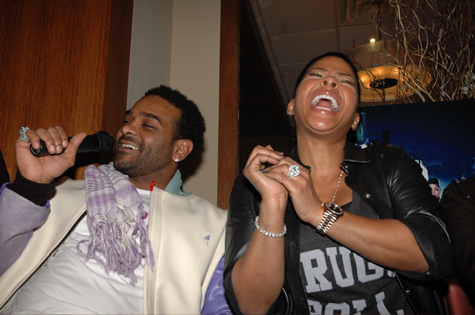
Out of respect for the 135th Street Agency and the wonderful ladies who work extremely hard for their clients, I had no intentions of blogging about this. If I can’t be honest with my readers about an event, product or anything else I will not write about it. The venue was plush. Very cute decor. The ladies put together a top notch event in less than 24 hours. With that said, the cast was somewhat off putting. They just annoyed me to no end. Chrissy Lampkin, Jim Jones, Olivia Longott and her manager Rich joined the 30 guests and witnessed our reactions to the scenes throughout the episode. Mona Scott-Young, the executive producer/creator of the show, curated the Q&A session.

Looks like Jimmy finally put a ring on it.

We all watched the first episode while shaking our heads. We laughed hard at Jimmy’s mother creating a song about her disdain for her son’s girlfriend. Several conversations were had at our table about how this hurts the portrayal of women of color. Chrissy received a number of questions in regards to the fight between her and Kimbella, the mother of Juelz Santana’s child. Chrissy answered the questions honestly. She did say she was not happy about the fight, but “life happens.” Chrissy was the most likeable of the bunch.  Her boo Jimmy though? He was very defensive, rude and disrespectful. Jim Jones took some of the questions as a personal attack instead of bloggers and journalists doing their jobs. He dismissed questions and hurled out a couple personal insults. He was rude.  I’m writing this as I should be rushing to get ready for the AEON magazine launch party and Jennifer Williams lip gloss launch party so I won’t go into specific details, but I think the SO summed it up best, “He’s a bird.” Precisely. Olivia seemed very bland. She was quiet and answered the questions very succinctly. Rich, who clearly has no respect for women based on what viewers saw the first season, was himself.

I didn’t watch the first season other than a couple episodes I caught when VH1 ran reruns. Based on how the cast behaved at the event, I will continue not watching this season. I also noticed that “press” has become interchangeable with bloggers. Why did I go to school to become an actual trained journalist? Bloggers made up 90% of the press at the event. Therefore, instead of objective questions there were questions from bloggers who made it known they were #teamChrissy or fans of whomever. Uhh, ok. Don’t be surprised if y’all see me start a new site solely dedicated to entertainment blogging. BALLIN’.

I’m kidding. I’d be miserable. I really could not care less about celebrities. Check out pictures from the event over on my boy Rae’s blog Stuff Fly People Like.

Note: Maybe I’m over analyzing this. But on Friday I wore my ‘fro because I was getting a sew-in the next day. It had a lot of shrinkage and no curl pattern. During the Q&A session Jimmy kept looking at my table and then running his hands over Chrissy’s smooth edges. Then he would move his hand up and down her long jet black weaved ponytail. Repeatedly. Not sure if this was a dig or what, but it seemed so unnecessary to do during a Q&A.

The Pink Book

I’d just left Harlem Tavern from a dope dinner with a fellow writer. Apparently NFL game night brings out the fine men. Harlem is definitely winning me over. It was late and I had accepted the fact that you all would not be getting a blog post today. I had to still had to do my hair (a three hour process), send two emails and find something to wear to a private dinner with the cast of Love & Hip Hop on Friday night. On top of that I had a mandatory training for work the next day.

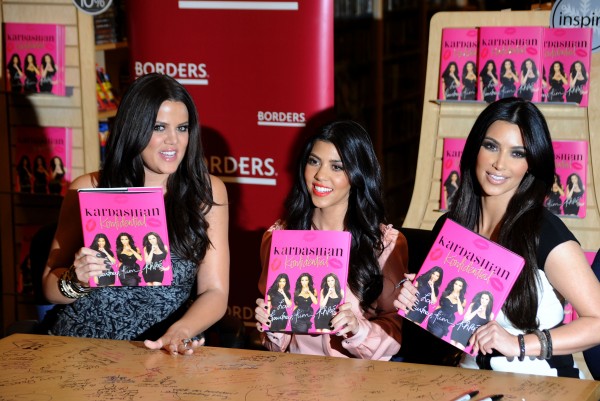
I sat on the train with my headphones in reading an article on The Root on my Blackberry. A bald man in his mid-forties interrupted my groove to ask for a pen. His clothes and bots screamed construction worker. He carried a huge block cell phone in his pocket, you know the kind that was around in the late 80s that only privileged people could afford. A yellow M&M bag sat by his feet. I handed him one of the five pens I keep in my bag at all times after he’d asked if I had one. I looked over to spot him pulling the pink book “written” by the Kardashians out of the M&M bag.

I am not endorsing this book. Hate to even give it publicity.

I had my headphones in so I didn’t really know what he was saying, but I saw him talking to the random guy sitting next to him. He handed my pen and the book to the guy sitting next to him. At that point I paused my music because I was curious to see what they were doing. Blame it on me being a journalist or just plain nosy. The man who’d asked for the pen said to his new partner in crime, “Roxy. Roxy. R-O-X-Y.” Man B looked like he didn’t want any part of whatever this man was asking him to do, but he obliged.

Man B opened the book to the first page and begin air drawing letters. I knew he wasn’t about to do what I thought he was going to do. Before I could blink man B signed Roxy’s name and a signature as if one of the Kardashians had autographed the book. Man A confirmed that he had just pulled a scum bucket move if I ever seen one. “It looks like Kim signed it herself.” He handed my pen back to me without so much as a thank you. I rolled my eyes putting and unpaused my music.

Shortly after man B moved to another seat, far away from the guy. It takes a special kind of dude to buy his girlfriend or wife a book as a gift to then have a complete stranger sign it as if the author signed it personally. She’s going to tell everybody she got an autographed copy of the Kardashian book. She’ll brag to her co-workers that her man got her this book & had it signed. She’ll most likely cherish this book if not for the sole reason that the “author” signed it. Talk about scandalous. I mean sure it’s appealing to want to add the special touch of an autographed copy of a book. But the deceit is so unnecessary. I’ve never understood liars, but it really irritates me when people lie about dumb shit. A man who pulls trickery like that will lie about anything. This is a huge character flaw.

Roxy, if you’re out there and your man rode the LIRR last night, the Kardashians didn’t sign that book boo. Your man is a liar. And he’s most likely sneaky and conniving. Reconsider, girl. Reconsider.

RIP Heavy D

Yesterday morning I had to stop for gas on the way to the train station because my car had below a quarter of a tank. Dougie Fresh was on the Tom Joyner Morning Show on 105.1 discussing who Heavy D was as a person. Apparently Heavy D was sort of Dougie’s protege, which resulted in them forming an incredibly tight bond. Dougie bragged that his friend never made one enemy in hip-hop. No one could honestly say they disliked him. He reiterated the fact that Heavy D was about positivity at all times. And he was that dude that would tell you the truth even if you didn’t want to hear it. In a genre heavily based on male bravado, rap battles/beefs, it is a hell of a feat to have been so loved never making an enemy. In that moment I wondered what my friends would say about me when I leave this earth. It wouldn’t be that I never had an enemy. Ha! Unexpectedly, I got choked up listening to Dougie talk about his late friend who died at the young age of 44 on Tuesday, November 8, 2011. I didn’t shed a tear for Steve Jobs although I tweeted about his death like the 500+ people I follow on Twitter. For some reason Heavy D was different. His death touched me. As we drove off from the gas station I kept repeating, “Forty-four is so young. Forty-four is young. Forty-four is young.”

Just this past weekend my best friend and I were discussing 90s music. We concluded it was the best. Many of the artists were legendary. Even the one hit wonders made classic songs that had the power to take you back to a place and time where you remember exactly what was going on in your life. Heavy D’s name came up as we reminisced in our hotel room. I don’t remember why we brought him up since the conversation had shifted from 90s music to 90s TV shows, but I do remember saying that I loved me some Heavy D. Three days later he was pronounced dead.

Heavy D always seemed comfortable in his own skin. He was that cool, chill dude. On top of me loving his music, I loved his personality. He exuded energy. I remember watching him on BET’s “Our Voices” in the 90s featuring my cousin, Rev. Calvin Butts, Donald Byrd, Bev Smith, Masta Ace discussing misogyny in hip-hop. My cousin, a young renowned model at the time, and he, a hip-hop artist, talked about the violence and degradation in rap. Oh, the days when BET used to have such good programming.

Forty-four is so young. I feel like I’ve said that now at least 25 times. We take each breath for granted. Every day we wake up, open our eyes, place our feet onto the floor we are blessed. Sometimes we don’t realize how easy it is for someone to be here today and gone tomorrow.

I salute Heavy D for always being such a positive male. From his upliftment of black women to his writing the theme song to Living Single to his fun songs we could dance to at a party, he was that dude. His last tweet represents the essence of his spirit. “Be inspired.” I needed to hear that today, D. Thank you. You will be missed. I wish we had appreciated you, like many others, while you were still here.

Plus One

Any party you’d want to attend in this city is held Monday thru Thursday. From artist’s listening sessions to film screenings to magazine issue release parties, it all goes down after work during the week. Partying on the weekend you will find a bunch of Long Islanders, Jersey Shore types and tourists. Folks tend to not leave their borough on the weekend as they are recouping from a week of commuting, work and partying. Don’t get me wrong, I will party on the weekend if there is something to do. Like the infamous Grits & Biscuit party that plays all southern music while women sweat out their perms and men try to keep up. There’s also 1st Saturdays at the Brooklyn Museum that I’ve been dying to get to. I guess now I’ll have to wait until summer because I don’t do lines in the cold. But why pay a cover and pay to drink on the weekend at a club when I can attend industry events for free that usually have an open bar and hors d’oeuvres during the week?

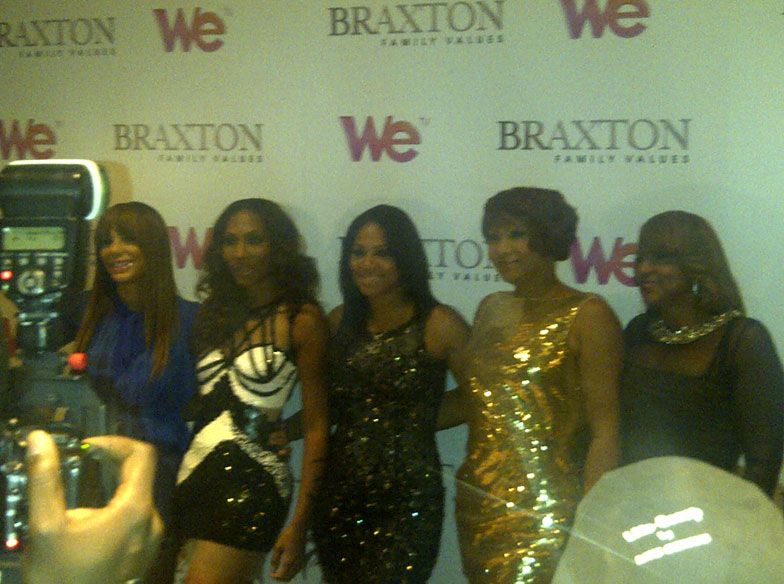
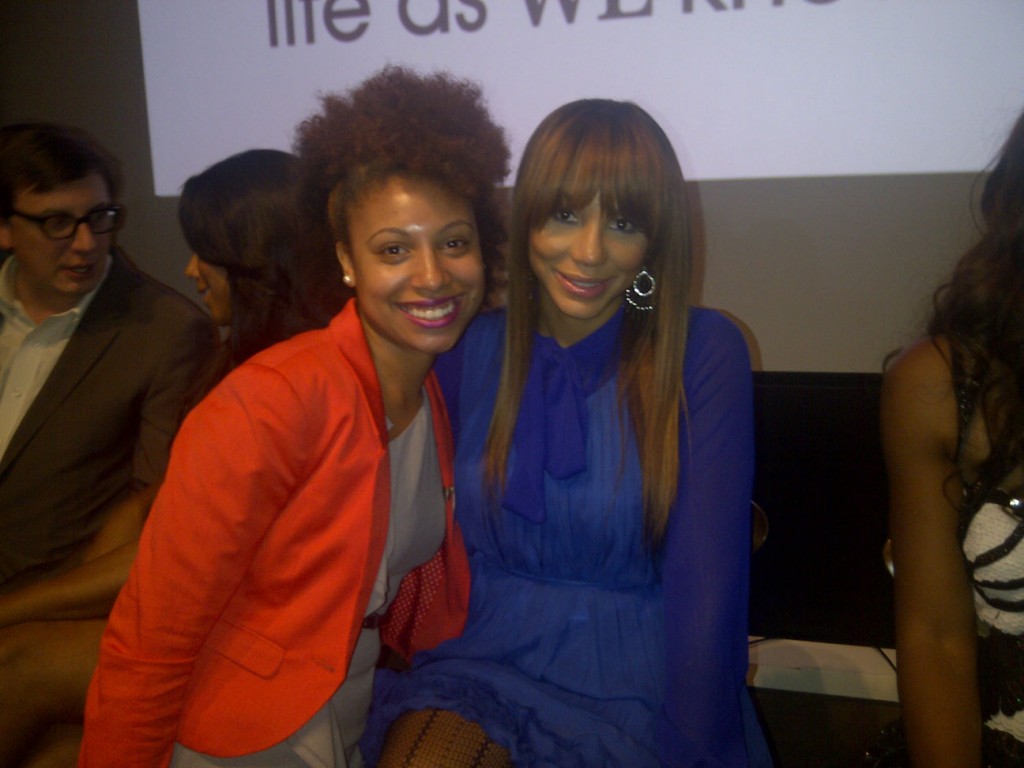
Last night I trekked to the Tribeca Grand Hotel in Tribeca, which I really think is Soho, to attend the Braxton Family Values private premiere with the cast. When I got to the shi shi foo foo hotel I ran into my girl Imani at the door. We hugged and air kissed cheeks. Imani reminded me of the young version of myself. Besides her chocolate skin, shoulder length hair and gorgeous looks, she is bright and ambitious. I love that she is like a sponge willing to absorb any and everything she can. If there was an industry event, Imani was there. Hip-hop Awards in Atlanta– she was there. Black Girls Rock taping in the Bronx– she did that too. She was on top of her game at such a young age; I admired her for that.

I promptly changed into my black stilleto pumps before entering. This is something you won’t understand if you’re not a New Yorker. We walk the streets in our flats and change into our heels that we usually carry in our oversized purses right on the street before entering into the venue. The PR reps whose company hosted the event were seated at a table taking names. If you weren’t on the list you likely weren’t getting in. In NYC there’s a list to get into anything worth going to. And if you’re on the list you’re usually allowed a plus one. Due to the clear instructions on the invite that only one person per media outlet would be allowed, I didn’t bother inviting a plus one. But it were times like these I wish my friends from home were here to be my plus one.


On the train ride to Tribeca I wondered whether or not I’d be lonely. Would I see anyone I know? Would I sit alone in the corner all night bored? Was I really in the mood to work the room by introducing myself to total strangers? And would I see my new archenemy who I’d been dying to see since she pulled that stunt a couple weeks ago (granted I’d never give her the satisfaction of acting a fool with her in public)?

It turns out I was in the sociable, i.e. networking mood. As soon as I walked in one of the PR reps recognized my name. We chatted for a bit, she handed me her card and I made a mental note to follow-up with her via email the next day. The venue was a cozy space with half love seats and lots of space to walk around. The red carpet was set up in the back to the left. Of course the celebs arrived late.  There was an unusual free coat check, open bar (I live for an open bar!) and great hors d’oeuvres. I spotted one of my favorite editors, Cece, chatting with a guy by the wall. I saw two other editors from a national magazine who have been great to me since I’ve been in NYC. We caught up for a bit as I ate my sliders and crabcake balls. Ironically, the same event I had wondered if I’d sit in the corner by myself all night was an event, like so many others, where I ended up knowing quite a few people there.

NY is like that. I swear if you’re black and educated in NYC (anywhere really) there’s one degree of separation. And black folks in the media? Forget about it. We all know each other. Several glasses of champagne, then vodka & pineapple juice later I thought about how I’d concocted a daunting plus one dilemma that ended up being nonexistent. I went. I ate lamb chops, sliders, chicken on a stick, lobster sandwiches, asparagus spring rolls and drank all the free liquor I wanted. And I met new people. Simple. We laughed at the premiere issue of “Braxton Family Values”, which airs Thursday on WE TV. I took pictures. Mingled a little more and eventually called it a night.

On the train ride there I thought about how lonely it can be in a city of over eight million people. I wished I had a crew to share some of these nights with. I worried if the night would be a bust and worth my commute to the city. Instead I was reminded why I moved to NYC.

New York is truly a magical place. Magical things happen at any given moment. Sometimes all you have to do is show up. As nice as it would have been to have one of my besties as a plus one, I think I was fine all on my own. Plus ones are great. But I also reminded myself, I, alone, am enough.

“We Found Love”

“You almost feel ashamed. That someone could be that important that without them you feel like nothing.”

The first time I watched Rihanna’s “We Found Love” was like staring in a mirror watching my life with an ex sans smoking 20 cigarettes at once or sitting in a tub full of water fully clothed. The lead single from Rihanna’s sixth album, Talk that Talk, has generated quite the buzz for one reason or another. From speculations to the leading male model Dudley O’Shaughnessy portraying Chris Brown to the chatter about the videos interpretation to anti-rape campaigners enraged by what they see as Rihanna portraying herself “an object to be possessed by men,” her latest video has everyone talking that talk.

Outside of being cinematically and thematically one of the best videos I’ve seen this year, “We Found Love” taps into a feeling so real it’s eery. Drugs symbolizing toxic love isn’t exactly a brand new concept. But Riri captures it like no other. When I heard the monologue at the beginning of the video I remember feeling: when it’s over and it’s gone you almost wish you could have all that bad stuff back so you can have the good. More than anything her latest video is about an addictive, dysfunctional relationship that has both parties involved so high off love (or the obsession with each other) they’d rather have the toxicity than be without each other.

Prior to this year I had never written about my own domestic violence experience, but I had written lots about my disgust for Chris Brown’s actions and the women who still supported him. It wasn’t until Rihanna’s infamous 20/20 interview with Dianne Sawyers that I realized why their situation in particular was such a touchy topic for me. Listening to Rihanna speak about the two of them becoming “dangerous for one another because it was sort of an obsession” was like reliving my own hurtful relationship from when I was 20-21-years-old. I saw myself in Rihanna. Every word she spoke about being embarrassed by what happened to her, being embarrassed by falling so deep in love with that type of person and loving that person so unconditionally that she went back even after he beat her, could have been my own. It was my story except I had no fame, riches or PR team. I could visualize Rihanna and Chris’ situation when she said, “He had no soul in his eyes, just blank” because I’d seen firsthand what she described.

What’s more unfortunate than the abuse (both physical and verbal, and I’d argue verbal abuse is far worse) is that like Rihanna, I went back. That type of love was intoxicating. I can hear the ‘that’s not real love,’ chatter now, but until you are in a relationship where you feel what it is like to think you can’t live or breathe without a person, you may not understand. “We Found Love” is only a four minute glimpse of the highs and lows of addiction to toxic love. You live to fight. And then make up. There’s an intensity of highs and lows. The highs are so high you hope they don’t end. Realistically you know they will. Your entire life becomes this bubble where that love and relationship are the only things that matter. And the lows? They’re the lowest of the low. Gut-wrenching pain and confusion. Getting through one day without an argument is a victory. And through it all you both convince yourself that as much as it hurts you need each other like you need air to breathe.

I adore Rihanna because of the her transparency in this video. She bares her soul through her art. For people like me, the authenticity of it makes it relatable. Each time I watch the video I remember how a love so toxic can be so alluring. But as hard as it is to imagine that I was once in something so destructive, I’m also reminded that I’ve never treaded remotely close to anything that toxic since. Growth is a beautiful thing.


Privacy Settings
We use cookies to enhance your experience while using our website. If you are using our Services via a browser you can restrict, block or remove cookies through your web browser settings. We also use content and scripts from third parties that may use tracking technologies. You can selectively provide your consent below to allow such third party embeds. For complete information about the cookies we use, data we collect and how we process them, please check our Privacy Policy
Youtube
Consent to display content from Youtube
Vimeo
Consent to display content from Vimeo
Google Maps
Consent to display content from Google